
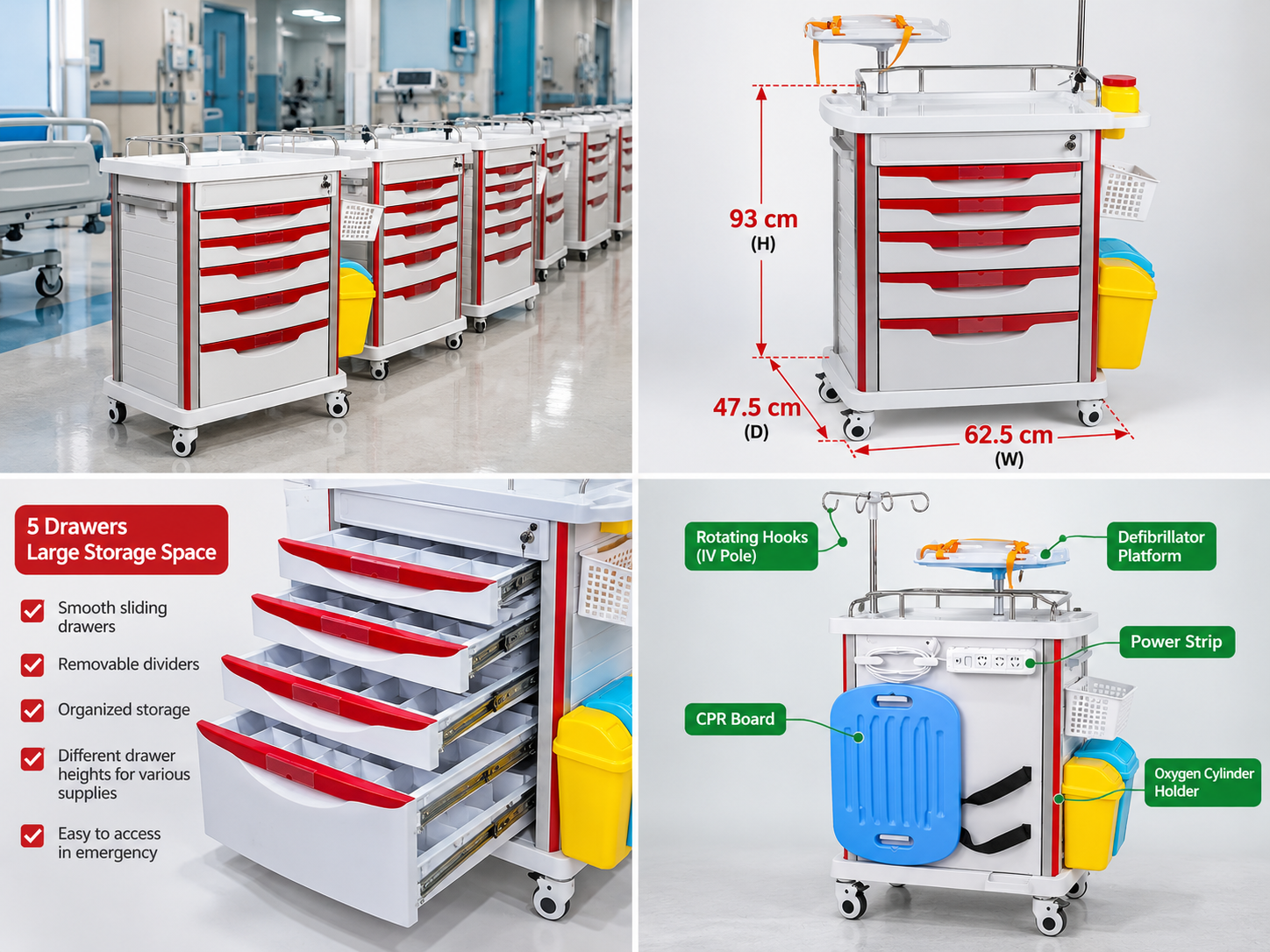
Crash Cart Dimensions: How to Choose the Right Size
Crash cart dimensions are not the same for every model. Size changes with the body design, drawer setup, and accessories fitted on the cart. Buyers should not look only at the overall width, depth, and height. Hospital space and real operating clearance matter too. These details affect how the cart moves and works in a real emergency.
If you are new to emergency carts, read our guide What Is a Crash Cart? for a basic overview.
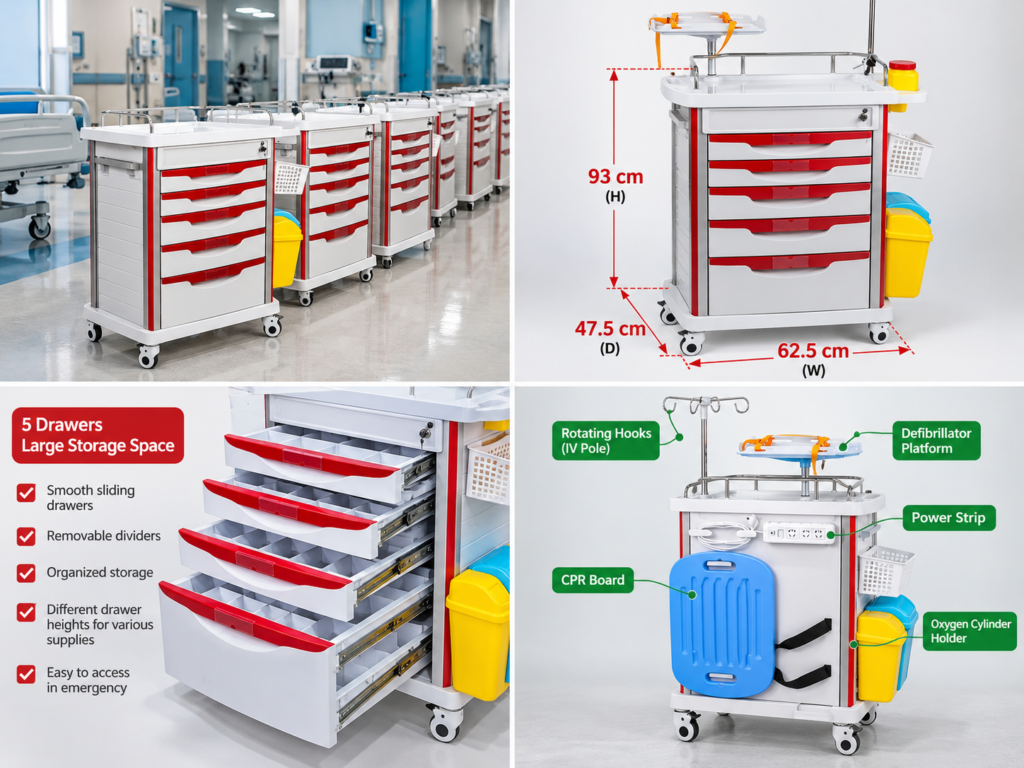
What Are Typical Crash Cart Dimensions?
No single crash cart size fits every hospital. Each maker designs carts for different needs. A cart built for a small clinic may be different from one used in a busy emergency department.
Here is one Airomay model as a reference point:
| Product | Overall Dimensions (W × D × H) |
|---|---|
| Airomay ABS Crash Cart | 62.5 cm × 47.5 cm × 93 cm |
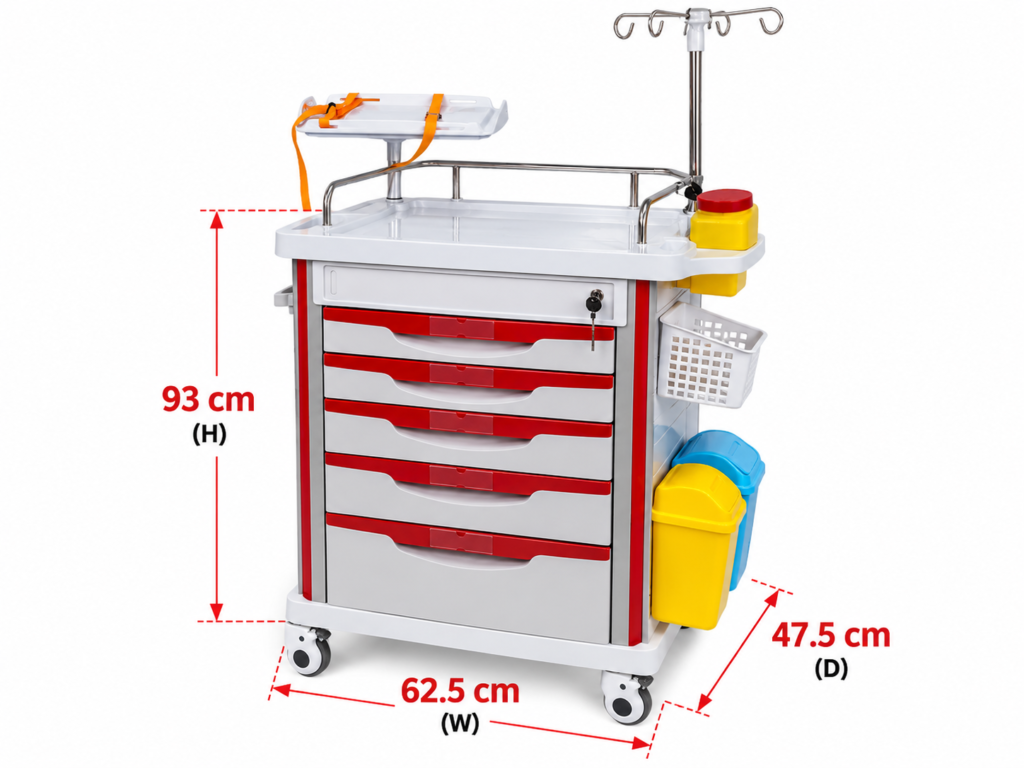
This is one Airomay model example. It is not a universal crash cart size. It is not an industry standard.
Buyers should treat any published size as a starting point. Always confirm the exact dimensions of the model under review. Two carts can look the same in a photo and still measure very differently.
Some carts are narrow and compact. Others are wider or taller. The difference can come from the drawer setup, body design, work surface, base, casters, and external accessories.
Why Do Crash Cart Dimensions Vary?
Cart size changes for clear product design reasons. There is no single formula.
- Number of drawers. More drawers can increase the overall height of the cart, depending on the drawer layout.
- Drawer dimensions. The width, depth, and height of the drawers affect usable storage space and may influence the overall cart dimensions.
- Body design. Different body and frame designs can change the outer dimensions of the cart.
- Work surface. A larger top surface can increase the width or depth.
- Base design. The base and wheel arrangement can affect the cart footprint.
- Caster design. Caster size can affect total height and the base configuration.
- External accessories. Extra items can extend beyond the main cart body.
- Product configuration. Different models may use different combinations of drawers, accessories, and structural parts.
The right cart should match the buyer’s space and product requirements rather than follow one fixed size.
7 Crash Cart Measurements Buyers Should Check
Buyers should check more than the basic width, depth, and height. Here are seven useful measurements.
1. Overall Width
Overall width is measured at the widest point of the cart. Buyers should confirm whether handles or fixed side parts are included in this measurement.
Width matters for doorways, corridors, elevators, and storage areas. A cart that is too wide may be difficult to move through a hospital.
2. Overall Depth
Overall depth is measured from front to back.
Buyers should check whether fixed parts at the front or back are included in the published measurement. Depth affects floor space, turning space, and the amount of working room around the cart.
3. Overall Height
Overall height normally describes the height of the cart itself.
When comparing suppliers, buyers should check whether raised accessories, such as an IV pole, are included in the stated height or listed separately.
This distinction is important when checking elevator access, storage areas, and other spaces with height limits.
4. Internal Drawer Dimensions
Outer cart size does not show usable storage space.
Buyers should ask for the internal width, depth, and height of the drawers when storage capacity is important. This gives a clearer idea of the space available inside the cart.
Our separate Crash Cart Contents guide covers what may be stored in an emergency cart.
5. Working Surface Height
Working surface height is measured from the floor to the main top surface.
It may be different from the total cart height because handles, rails, or other parts can extend above the work surface.
Buyers should check this measurement when comparing different cart designs.
6. Caster Diameter
Caster diameter is part of the physical specification.
Caster size can affect the cart’s overall height and mobility. Buyers should confirm the caster diameter with the supplier instead of assuming that every crash cart uses the same size.
7. Overall Clearance With Accessories Installed
This is an important measurement in real hospital use.
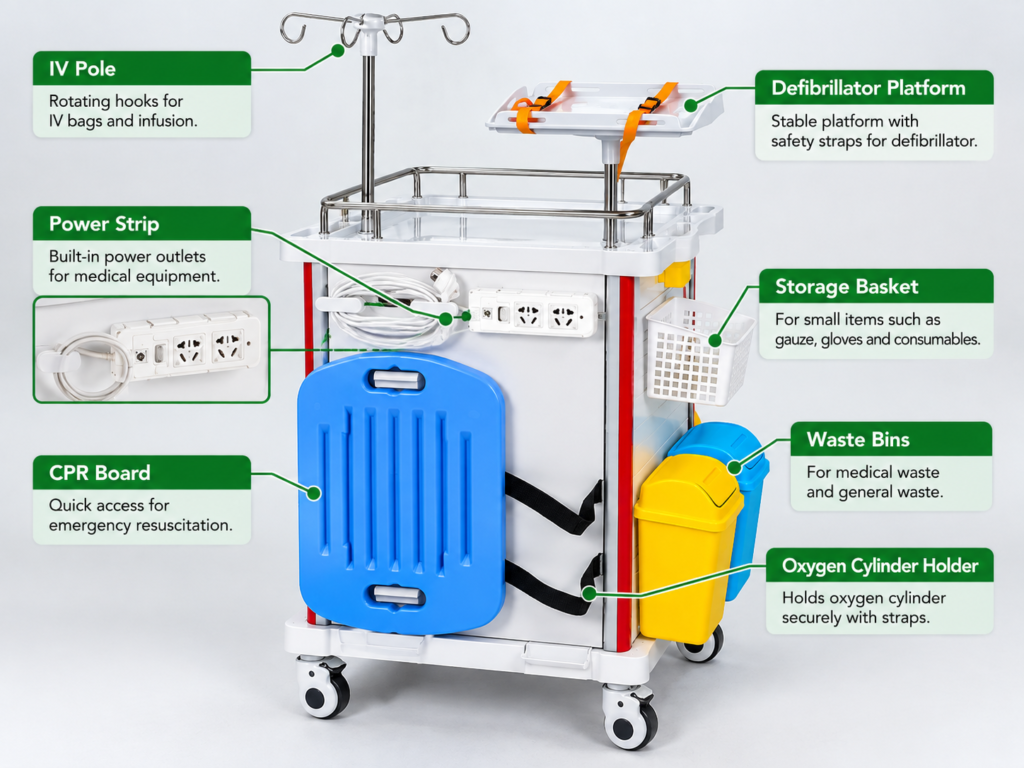
The published cabinet dimensions may not include the space required by external accessories. An IV pole, oxygen cylinder holder, defibrillator platform, or other side-mounted part can extend beyond the main cart body.
A cart body may fit through a doorway, while the fully configured cart requires more space.
For this reason, buyers should consider two different measurements:
- Published cart dimensions: the dimensions stated for the main cart body.
- Real operating clearance: the total space required when the cart and its accessories are ready for use.
This distinction can help prevent fitting problems after delivery.
Airomay Crash Cart Measurement Example
Here is one real Airomay product example:
| Item | Details |
|---|---|
| Product | Airomay ABS Crash Cart |
| Overall Dimensions | 62.5 cm W × 47.5 cm D × 93 cm H |
Buyers can use the same W × D × H format when comparing different models and suppliers. It keeps the comparison clear.
A few points are important:
- This is one Airomay model, not a fixed industry standard.
- Other models may have different dimensions.
- Internal drawer dimensions and caster size should be confirmed for the exact model being ordered.
- Accessory clearance should also be checked if the cart requires external accessories.
For hospital projects, using the same measurement format across supplier quotations makes it easier to compare different models.
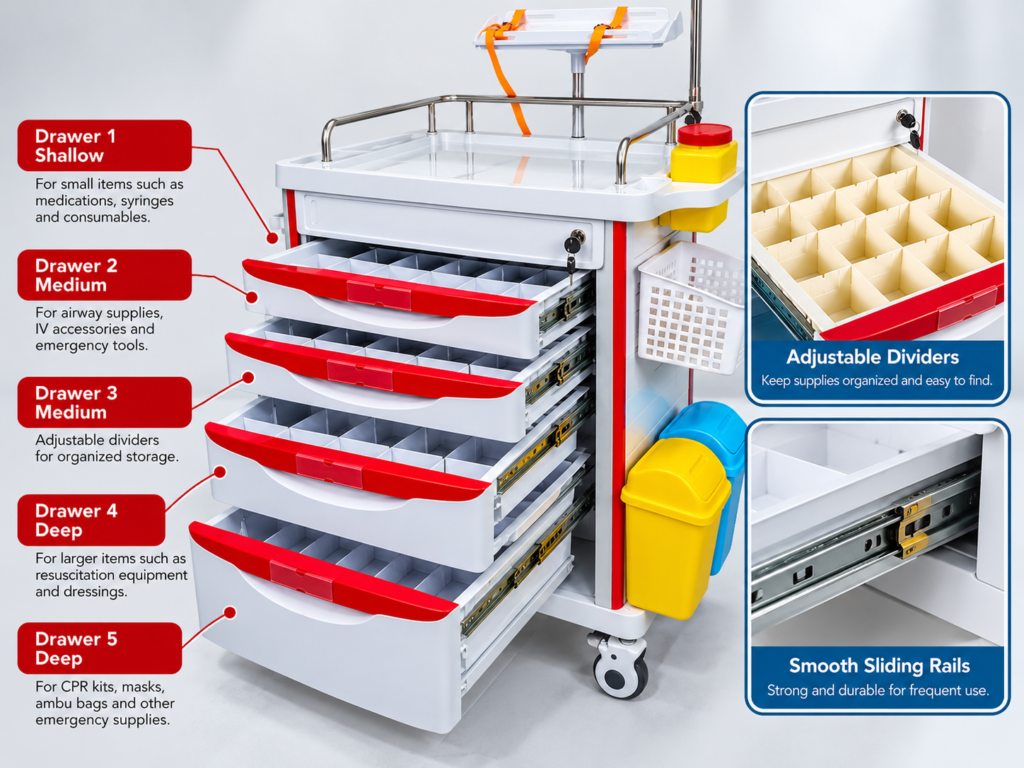
How Drawer Configuration Affects Crash Cart Size
Drawer configuration affects both the external size of a cart and the usable space inside it.
- Drawer quantity. The number of drawers can affect the total cart height and internal layout.
- Drawer dimensions. Wider, deeper, or taller drawers change usable storage space. Their effect on the overall cart size depends on the cart design.
- Internal storage space. External cart size alone does not show the real capacity of the drawers.
- Overall cart height. The frame, drawer configuration, base, and casters together affect the final height.
- Drawer dividers. Dividers help organize the drawer but can reduce some usable internal space.
A larger cart is not always the right choice. Buyers should compare external dimensions with usable internal space and the requirements of the hospital.
How Accessories Affect Crash Cart Space Requirements
Accessories can add to the space a crash cart needs.
Common examples include:
- Defibrillator platform or shelf. It can extend from the top or side of the cart and needs space for the device.
- IV pole. It adds vertical space when raised.
- Oxygen cylinder holder. A side- or rear-mounted holder can increase the practical width or depth.
- CPR board. A rear-mounted board can require additional clearance behind the cart.
- Side-mounted accessories. Bins, holders, and brackets can increase the effective width.
These items may not be included in the supplier’s published cart-body dimensions.
A real manufacturer example shows why this matters. Harloff lists one M-Series emergency crash cart at 111.1 cm H × 93.3 cm W × 55.9 cm D for the cart only. With its emergency accessory package installed, the listed overall dimensions increase to 182.4 cm H × 100.2 cm W × 55.9 cm D.
View the Harloff M-Series Emergency Crash Cart specifications
This example does not represent a universal crash cart size. It shows why buyers should check both the cart-body dimensions and the dimensions of the fully configured cart.
How to Choose the Right Crash Cart Size for a Hospital
There is no single best size. The right size depends on the hospital environment, storage requirements, equipment needs, and cart configuration.
A simple process can help:
- Check the route. Measure the narrowest doorway, corridor, and elevator opening the cart must pass through.
- Check the storage area. Measure where the cart will stay when not in use. Leave enough room to open the drawers.
- Check the working area. Consider the space needed around the cart when staff use it.
- List the equipment and accessories. Include equipment placed on the work surface and accessories attached to the cart.
- Plan the drawers. Decide the required number of drawers and the usable internal space needed.
- Consider mobility. Check the cart footprint, caster configuration, and available turning space.
- Check the working height. Compare the main work surface height between models.
- Confirm the final specifications. Ask the supplier for exact dimensions before ordering.
This process helps buyers find a cart that fits the available space and required configuration.
What Crash Cart Dimensions Should Buyers Include in an RFQ?
A clear RFQ helps the supplier understand what the buyer needs. It also reduces back-and-forth communication.
Buyers can use this table when preparing an inquiry:
| Specification | What the Buyer Should Confirm |
|---|---|
| Overall dimensions | Width × Depth × Height |
| Drawer quantity | Number and configuration |
| Internal drawer dimensions | Confirm usable storage space |
| Caster diameter | Confirm with supplier |
| Accessories | List required accessories |
| Operating clearance | Consider external accessories |
| Quantity | Number of carts required |
| Destination | Country or port |
Clear dimensional requirements can reduce misunderstandings between the buyer and supplier.
They also make it easier to compare quotations. Two carts with similar external dimensions may have different drawer space, accessory layouts, or operating clearance.
Buyers who are ready to compare products can review the available Airomay Crash Cart models and check each configuration against their project requirements.
FAQ
What are standard crash cart dimensions?
There is no single universal size for every crash cart. Dimensions vary by model, drawer configuration, body design, and accessories. Buyers should confirm the exact dimensions of the model they plan to order.
How tall is a crash cart?
Crash cart height varies by model. Buyers should check both the overall cart height and the working surface height. They should also confirm whether raised accessories are included in the stated dimensions.
How many drawers does a crash cart have?
Drawer quantity varies by model and configuration. Different designs may use different numbers and sizes of drawers. Buyers should select the configuration based on their storage and project requirements.
Do accessories affect crash cart dimensions?
Accessories may not change the published dimensions of the main cart body, but they can increase the practical space required. IV poles, oxygen holders, defibrillator platforms, and other external accessories should be considered when planning operating clearance.
What dimensions should I send to a crash cart manufacturer?
Provide the required width, depth, and height. Also include drawer requirements, accessories, and any important space limits, such as doorway or storage dimensions. For a quotation, include the required quantity and destination as well.
Conclusion
When comparing crash carts, do not compare W × D × H alone. Check the usable drawer space and the clearance required after accessories are installed. For hospital projects, confirm these dimensions with the supplier before placing an order.
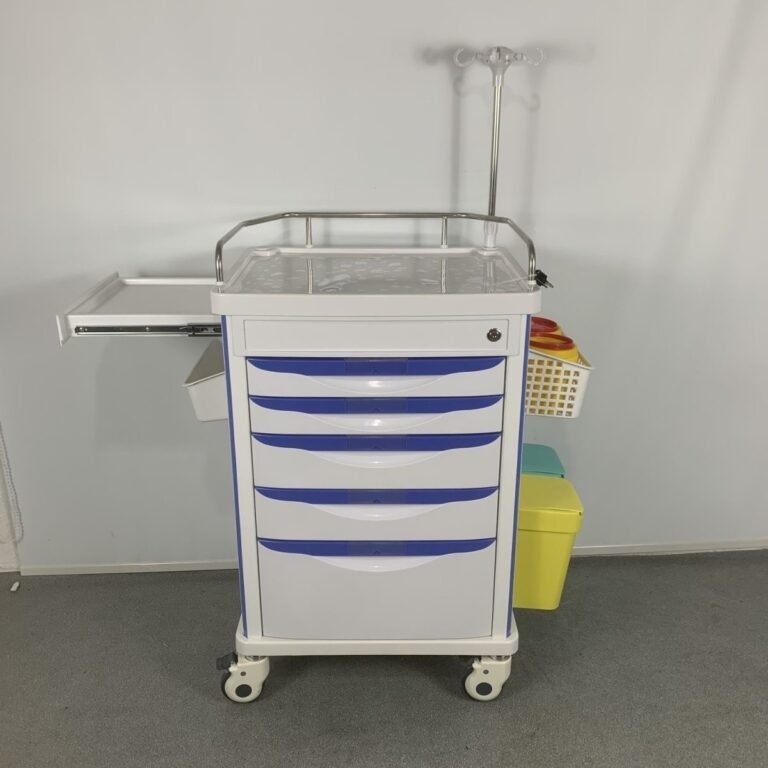
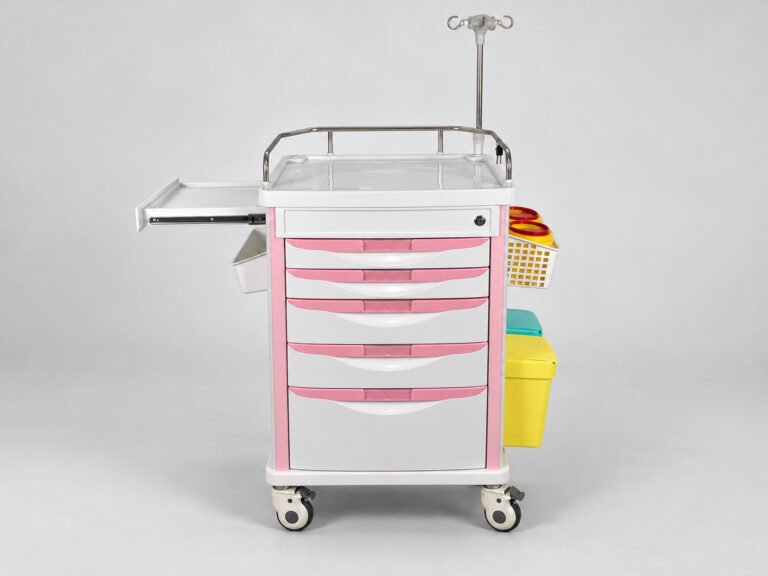
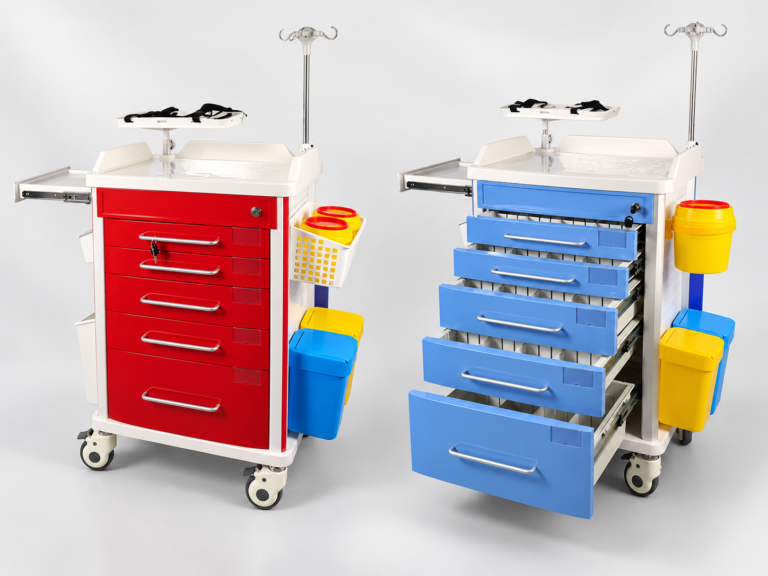

[…] For product size, see our Crash Cart Dimensions guide. […]
[…] Crash Cart Dimensions for the wider measurements buyers should […]