
Crash Cart Contents: What Is Inside a Crash Cart?
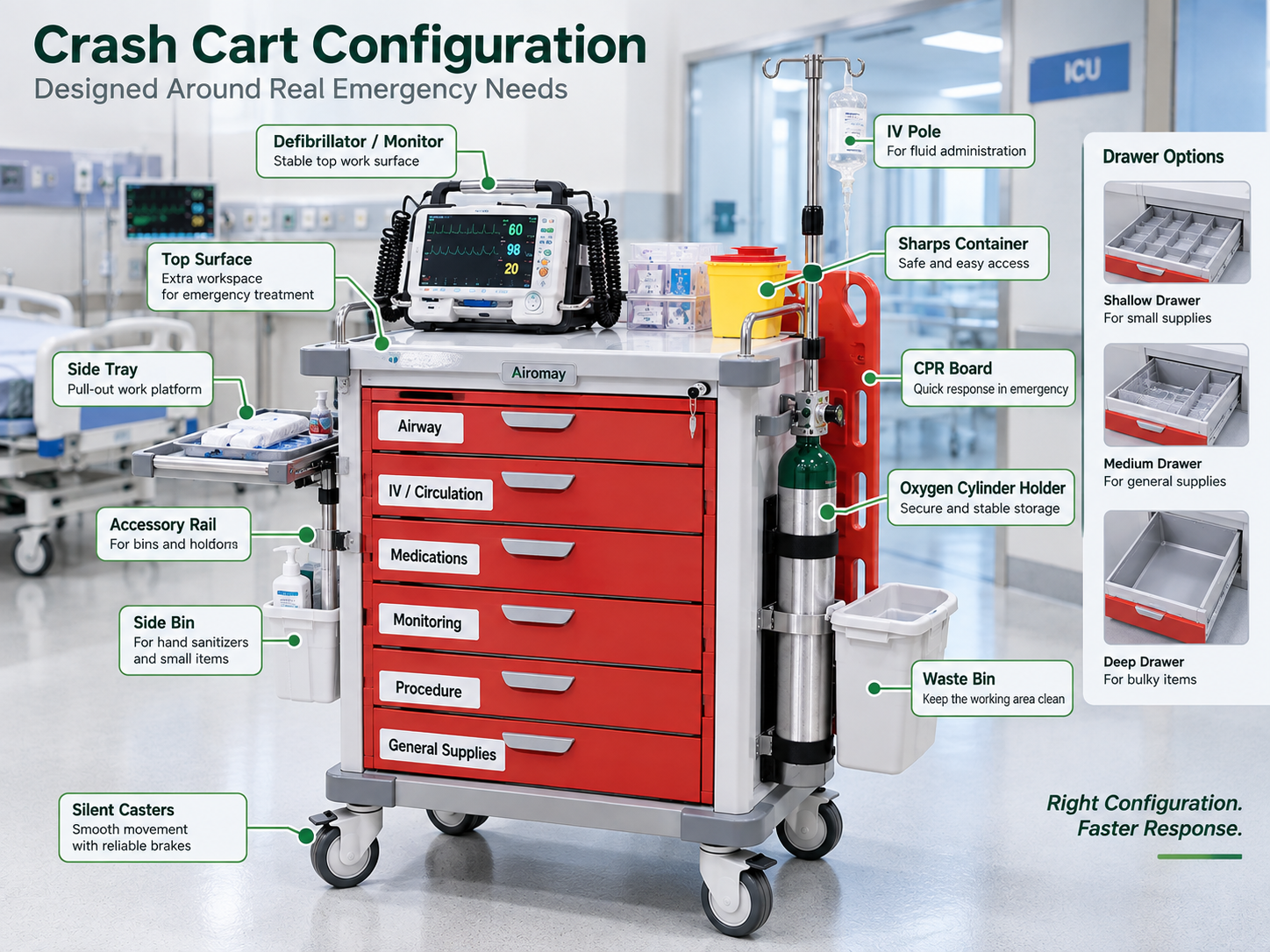
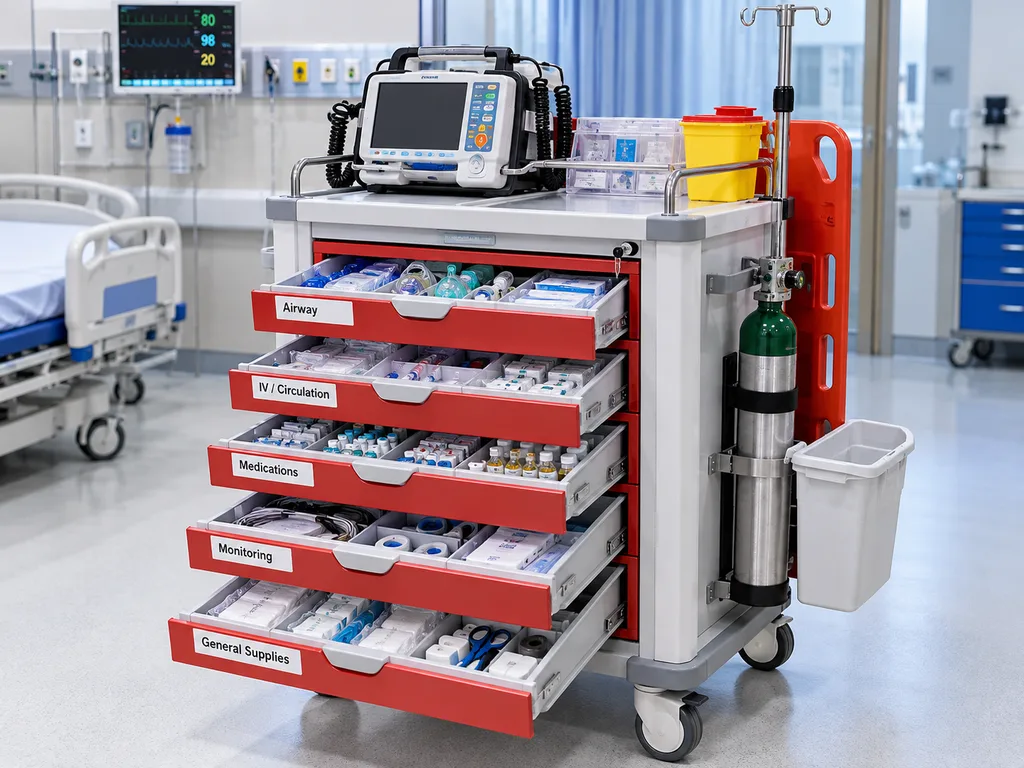
Crash cart contents usually include airway and breathing supplies, IV and circulation items, emergency medications, monitoring and defibrillation accessories, procedure supplies, and personal protective equipment. A defibrillator, CPR board, oxygen cylinder, and sharps container often sit on top or on the outside of the cart. The exact list depends on hospital policy, local rules, and the department that uses the cart.
Crash cart supplies typically fall into six main groups: airway management, circulation support, emergency medications, monitoring equipment accessories, procedure supplies, and personal protective equipment. The specific items within each group vary by hospital policy, department needs, and patient population served.
This guide explains what is normally found in and on a crash cart. It also explains how the required supply list shapes the drawers, accessories, and physical design of the cart. If you are new to emergency carts, read our guide What Is a Crash Cart? for a general introduction.
What Are the Main Crash Cart Contents?
Most crash carts carry the same broad types of items. They are grouped by function, not by brand or brand name.
- Airway and breathing supplies
- Circulation and IV supplies
- Emergency medications
- Monitoring and defibrillation accessories
- Procedure and general supplies
- Personal protective equipment and waste items
These broad groups are common, but the exact items can vary between hospitals. One hospital may stock a full range of airway sizes. Another may stock fewer sizes and add more IV items instead. Both are correct if they follow the facility’s own protocol.
What Is Usually on Top of a Crash Cart?
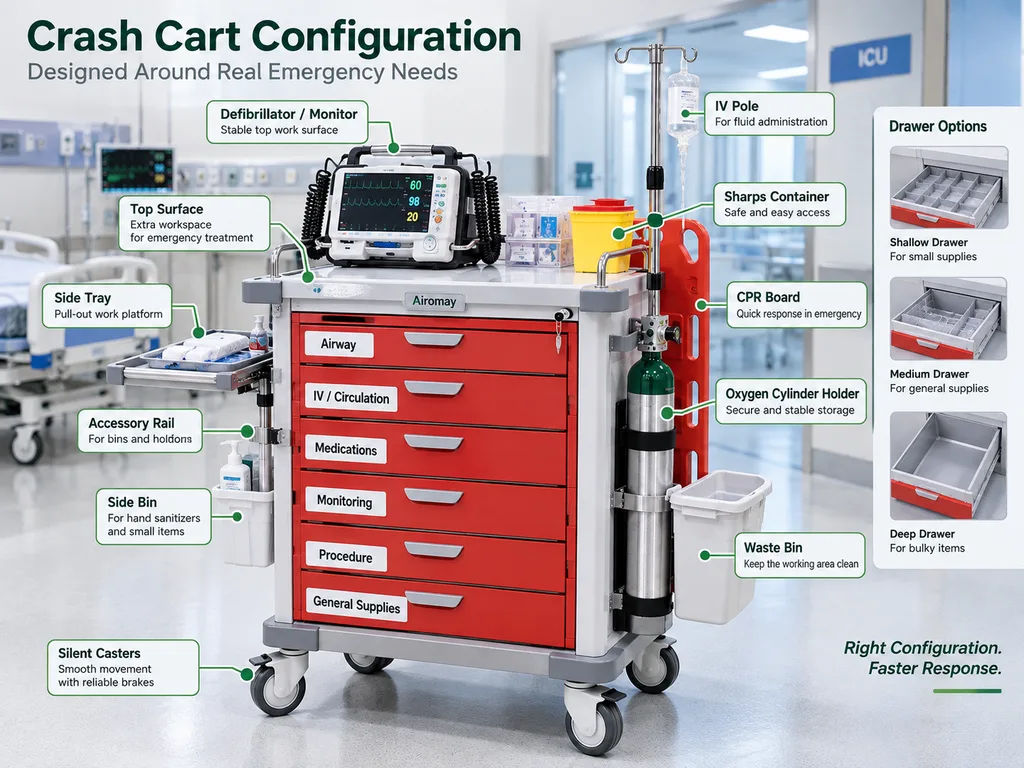
Not everything fits inside a drawer. Some items are bulky, heavy, or needed within seconds. These items often sit on the top surface or attach to the outside of the cart.
Common examples include:
- A defibrillator or monitor
- A CPR board
- An IV pole
- An oxygen cylinder holder
- A sharps container
- A waste bin
- Accessory rails, side bins, or holders
The top surface also works as a small working area. Staff need space to open a package or place a device. A crowded top can slow a team down.
Not every hospital uses the same setup. Some keep the defibrillator on a separate stand. Some mount the oxygen cylinder at the side. Some use a cart with no top equipment at all. The right setup depends on the hospital’s protocol and the space available in the room.
What Is Usually Inside a Crash Cart?
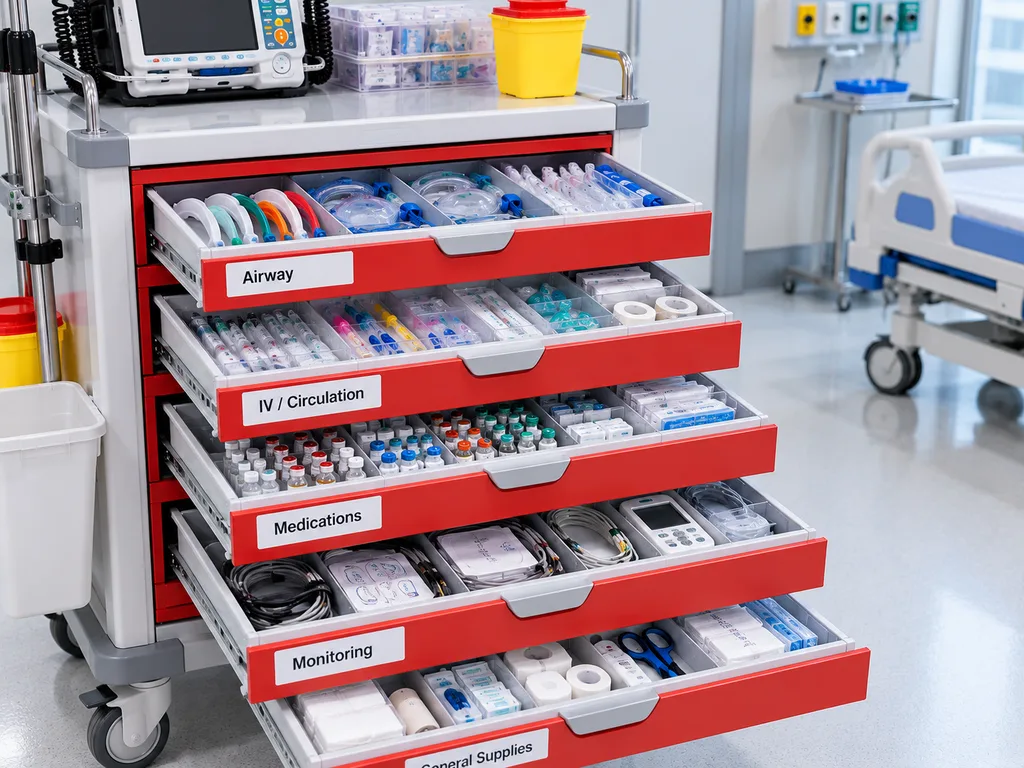
Most carts use drawers to separate supplies by function. This makes items easier to find and easier to restock. The drawer layout is not the same everywhere, but the functional groups are often similar.
Airway and Breathing Supplies
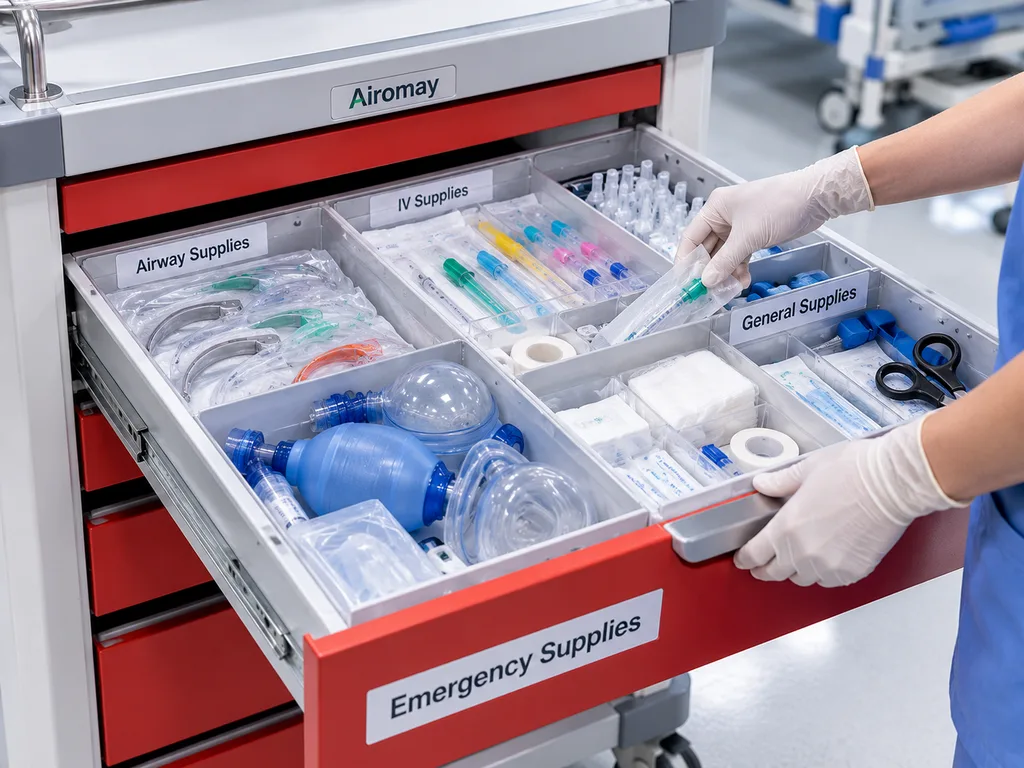
This group supports the airway and helps with breathing. Typical items include airway tubes in several sizes, bag-valve masks, masks, suction catheters, and oxygen tubing. Some carts also carry a laryngoscope handle with blades and spare batteries.
Sizes matter here. A cart used for children needs a wider range of small sizes. A cart used only for adults needs fewer sizes.
Circulation and IV Supplies
This group supports IV access and fluid delivery. Common items include IV catheters in different gauges, IV tubing, syringes, needles, alcohol swabs, tourniquets, and tape. Some hospitals also store IV fluids separately on a shelf or in a lower drawer.
Sharp items should be stored and handled according to the hospital’s safety policy.
Emergency Medications
Emergency medications are stored in a dedicated drawer or tray. This drawer is often locked or sealed for safety and control.
The exact medication list is a clinical decision. It is set by hospital policy, clinical protocols, and local regulations. Some hospitals use pre-filled syringes. Others use vials. Some keep medications in a separate sealed tray that is swapped after use.
Medication doses and treatment steps are not covered here, because those belong in the hospital’s clinical protocol.
The Joint Commission notes that emergency cart contents should be secured while still remaining readily accessible when needed.
Monitoring and Defibrillation Supplies
This group covers the accessories used with monitoring and defibrillation equipment. Typical items include electrode pads, ECG electrodes, conductive gel, cables, and spare batteries.
These items wear out or run down over time. Hospitals often give them their own drawer or their own spot on the top surface. That way, staff can check them without opening the whole cart.
Procedure and General Supplies
This group holds the small items that support many different tasks. Common examples include gloves, sterile gauze, dressings, scissors, a thermometer, a blood pressure cuff, a stethoscope, specimen containers, and pens with paper for records.
Personal protective equipment also belongs here or in its own spot. Gloves, masks, eye protection, and gowns should be easy to reach before staff touch a patient.
Are All Crash Carts Stocked the Same Way?
No. There is no single crash cart contents list that fits every hospital. Contents differ for good reasons.
| Reason for Difference | Example |
|---|---|
| Facility policy | Each hospital writes its own approved list |
| Country or local rules | Regulations change by region |
| Department | Emergency, ICU, operating room, and ward carts differ |
| Patient group | Adult and pediatric carts need different sizes |
| Clinical protocol | Teams stock what their protocol requires |
| Available equipment | The cart must match the devices in use |
A pediatric cart needs smaller airway items and smaller IV sizes. An operating room cart may carry items that a general ward cart does not. A small clinic may stock a shorter list than a large teaching hospital.
Hospital teams should always follow their own policy, clinical protocol, and local requirements. This article describes common practice. It does not replace a facility’s approved list.
How Should Crash Cart Contents Be Organized?
Knowing what belongs in a cart is only half the task. Staff must also find items fast, often under pressure. Good organization supports that.
Useful design features include:
- Drawer dividers that keep small items in place
- Clear labels on drawers and on the inside
- Adjustable compartments that can change with the list
- Different drawer depths for bulky and small supplies
- The same layout across every cart in the hospital
- A lock, seal, or tamper-evident system
A consistent layout can help staff find the same type of supplies in the same place across different carts.
No single drawer layout is correct for every hospital. The layout should match the hospital’s approved list and its staff habits.
How Crash Cart Contents Affect Cart Configuration
This is where clinical storage needs meet product design. The required supply list can help determine which cart configuration is suitable.
| Required Need | Useful Cart Feature | Why It Helps |
|---|---|---|
| Many small supplies | Adjustable dividers and shallow drawers | Items stay in place and are easy to count |
| Bulky supplies or fluids | Deeper drawers | Large items fit without crushing others |
| Defibrillator stored on top | Wide, strong top work surface | The device sits safely with work space left |
| Oxygen cylinder required | Cylinder holder or bracket | The cylinder stays upright and secure |
| Side accessories needed | Accessory rails, side bins, or holders | Extra items stay off the work surface |
| Sharps stored on the cart | Mounted sharps container | Reduces handling risk |
| Controlled storage needed | Central lock or seal system | Shows the cart was not opened since the last check |
| Frequent movement | Durable casters and reliable brakes | The cart rolls smoothly and stays still |
A cart with the wrong drawer depth wastes space. A cart with no oxygen holder may not fit the facility’s required setup. A cart with weak casters can also be harder to move through hospital corridors.
These may look like small design details, but they affect how well the cart fits its required contents and working environment.
Once the cart is stocked, regular inspection helps make sure supplies stay complete and ready. See our Crash Cart Checklist: How to Check a Crash Cart for the inspection process.
The Pennsylvania Patient Safety Authority also provides a sample emergency crash cart checklist for monitoring supplies and equipment.
Crash Cart Contents FAQ
What are the main contents of a crash cart?
Most carts carry airway and breathing supplies, IV and circulation items, emergency medications, monitoring and defibrillation accessories, procedure supplies, and personal protective equipment.
Is every crash cart stocked the same way?
No. Contents vary by hospital policy, local rules, department, patient group, and clinical protocol. The hospital’s own approved list always comes first.
What is usually kept on top of a crash cart?
Common items include a defibrillator, a CPR board, an IV pole, an oxygen cylinder holder, a sharps container, and side accessories.
How are crash cart supplies organized?
Most carts use drawers grouped by function. Dividers, labels, adjustable compartments, and a consistent layout help staff find items quickly.
Who decides what should be in a crash cart?
The decision belongs to the hospital’s clinical and quality teams. It follows local requirements and the facility’s own protocol.
Conclusion
Crash cart contents usually cover airway, circulation, medications, monitoring, procedure supplies, and protective equipment. The exact list changes from one hospital to another. The list should always follow hospital policy and local rules.
The best result comes when the contents list is agreed first, and the cart is then configured to hold that list safely and clearly.
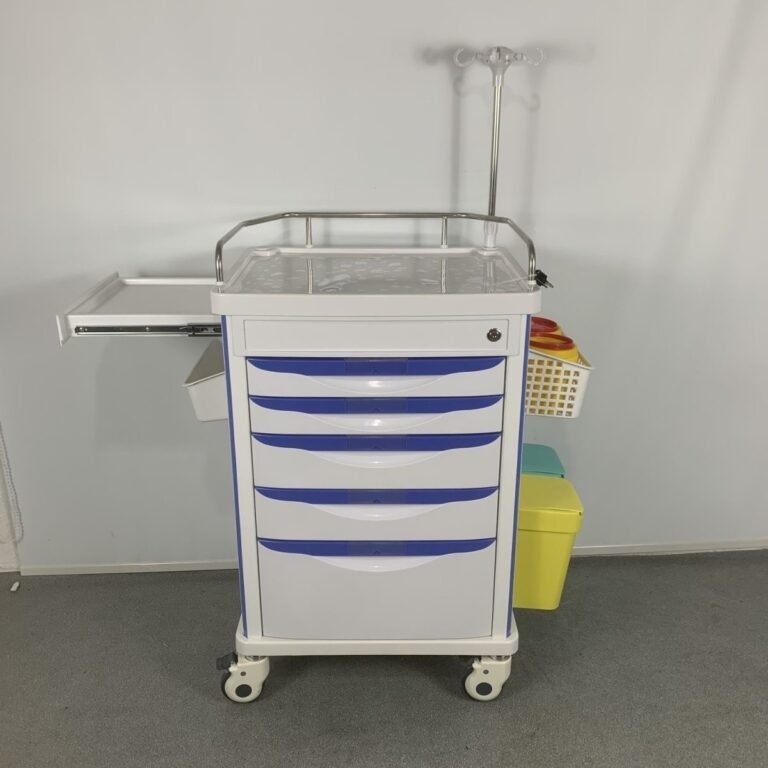
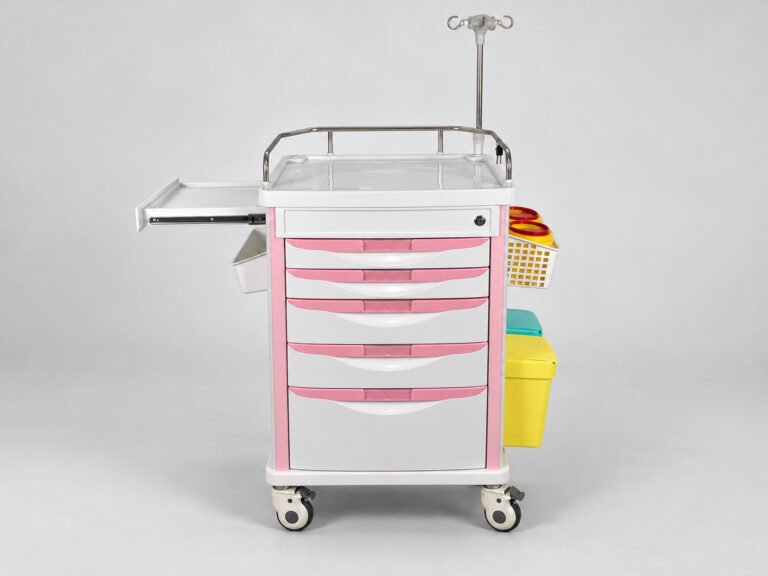
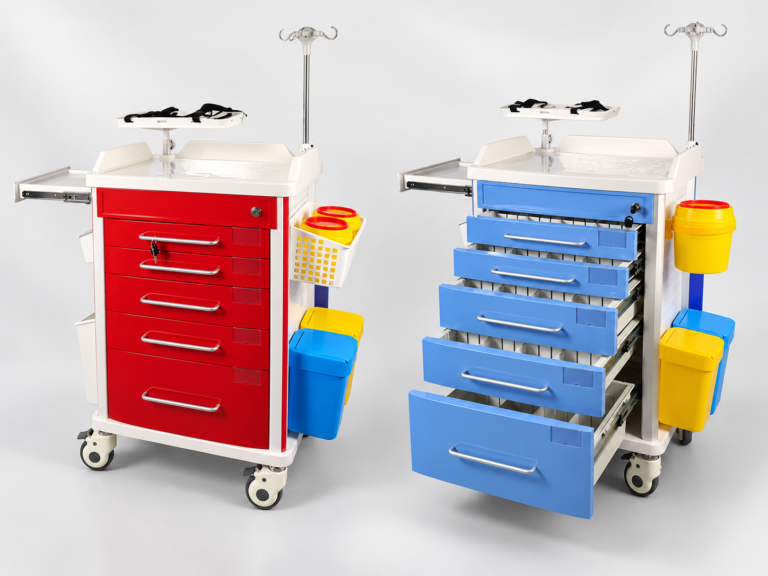

[…] This article focuses on the cart itself. For information about the medical items stored inside, see our guide to crash cart contents. […]